TL;DR
If you work in HR and have spent any time online in the past months, the topic of salary transparency has surely not escaped your attention. The topic is suddenly everywhere.  With the EU Pay Transparency Directive on the way, many employers are trying to understand what’s actually changing, and how big of a shift this really is.

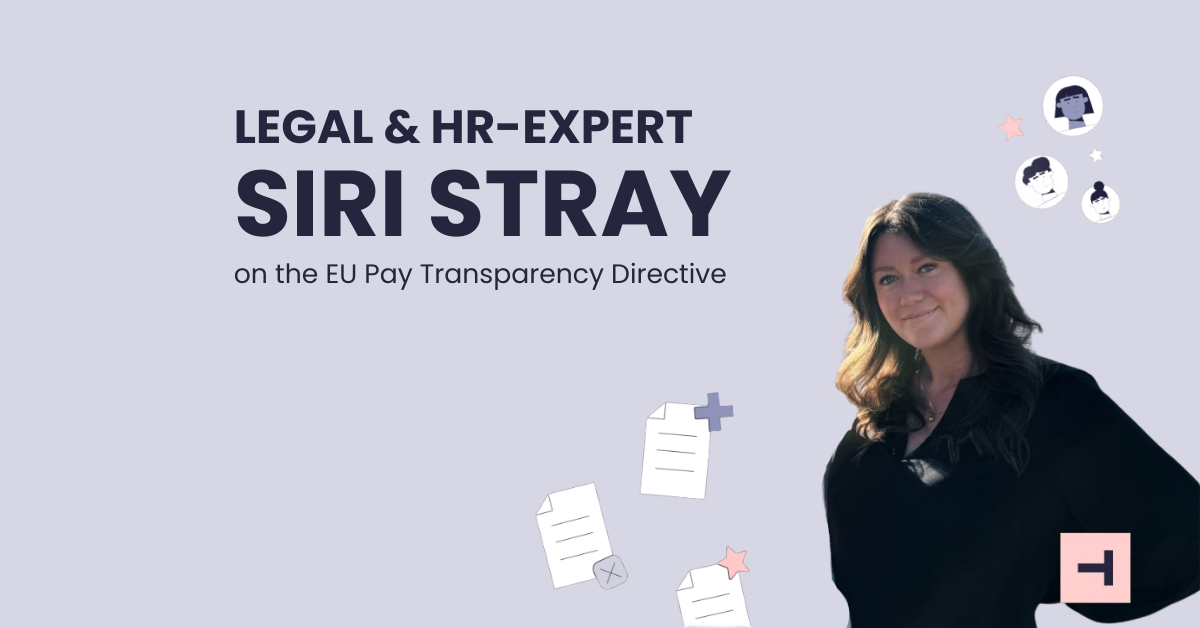
To cut through the noise, we sat down with our very own Siri Stray, People & Legal Associate and all things legal & HR expert, to explain what the directive is really about, and what HR teams and leaders need to know to prepare.

Overview
- What is the EU Pay Transparency Directive?
- Why is the directive coming now?
- When does the directive take effect?
- Which companies will it concern?
- How will it change recruitment?
- How will it change employee rights?
- What is “work of equal value” and how is it assessed?
- What happens if a gender pay gap is identified?
- How does enforcement change?
- How can companies and HR teams prepare now?
- Reflections
First things first: what is the EU Pay Transparency Directive?
"The Pay Transparency Directive is an EU law (Directive (EU) 2023/970) designed to strengthen equal pay between women and men. In short, it requires employers to be more open about how pay is set, both during recruitment and once people are employed.
It introduces concrete transparency obligations, reporting requirements for larger employers, and stronger enforcement mechanisms when unjustified gender pay gaps appear. The goal is not just to measure pay gaps, but to actually fix them. "
Why is this directive coming now?
"I would answer quite simply to this: because the gender pay gap in the EU has barely moved for years. On average, women still earn around 12% less than men. While equal-pay laws have existed for a long time, they haven’t been effective enough in practice, largely because pay systems have been difficult to understand and challenge.
So, the directive is a part of a broader EU push on equality and social rights. By adding transparency, reporting and shifting the burden of proof, the EU is trying to give employees real tools, and employers a clear framework to work within."
When does the directive take effect?
"EU and EEA countries must implement the directive into national law by 7 June 2026. Some countries are already ahead, while others are still working on it, but that’s the formal deadline.
From an employer perspective, this means now is the time to prepare. Many organizations will need time to get their data, structures and communication ready. In many cases, this can mean up to 12–18 months of preparation. That said, the timeline will look different for different companies. For smaller organizations, preparation may be closer to 3–6 months.
So, different timings for everyone prior to the deadline, but there is a common deadline for all."
Which companies will this concern?
"All employers with workers in an EU member state will be concerned with this to some extent, regardless of where the company is headquartered.
That said, the most demanding requirement, mandatory gender pay gap reporting, only applies to companies above certain headcount thresholds. It starts with employers with 150 employees or more and later expands to include those with 100+ employees.
Smaller employers are not exempt from everything. They still must follow the rules on recruitment transparency and employee access to pay information."
You mention recruitment now. What changes in this area?
"Yes, I see this as particularly important, as there are two big changes.
First, employers must provide candidates with information about the starting salary or salary range for a role. They can do that either in the job ad or before the first interview.
Second, employers are no longer allowed to ask candidates about their salary history. The idea is to prevent past inequalities from being carried forward into new roles.
On top of that, job ads and pay-setting criteria must be gender-neutral."
That sounds like a lot more evened out power dynamics towards candidates. What about once they become employees? Do employee rights change in any way?
"Employees gain the right to understand how pay is set and how progression works. Employers must make their pay and career criteria accessible and gender neutral.
Employees can also request information about their own pay level, and the average pay levels of colleagues of the opposite sex doing the same work or work of equal value.
This information is provided at group level, not as individual salaries, and must be broken down by gender, where applicable."
How is “work of equal value” assessed?
"By work of value, we don't necessarily mean job titles. It’s about what the job actually requires.
Roles are compared using gender-neutral criteria such as skills, effort, responsibility, and working conditions. That’s why structured job evaluation and clear job architecture become so important. Having this all in place will serve companies greatly, as it will allow employers to compare roles fairly, even across different functions."
What happens if a gender pay gap is identified?
"If reporting shows a pay gap of more than 5%, within a category of workers performing the same work or work of equal value, that cannot be justified by objective, gender-neutral reasons, and the employer doesn’t correct it, the company must carry out a joint pay assessment with employee representatives.
That assessment looks at the causes of the gap and leads to concrete measures to close it."
How does enforcement change?
"One of the biggest shifts is the burden of proof. If there are indicators of discrimination, it’s the employer who must prove that there was no pay discrimination, not the employee.
Member States must also introduce penalties that are “effective, proportionate and dissuasive”. This can include compensation, fines, orders to change pay structures, and in some cases exclusion from public tenders."
This sounds like a lot to prepare for. What should HR teams and companies do now? Is there anything you can recommend?
"Most importantly, I would say to start early and focus on the foundations.
Most organizations need to:
- clean up pay and HR data,
- build or refine job architecture and job evaluation,
- define clear, gender-neutral pay and progression criteria,
- train managers to handle pay conversations, and
- plan how to communicate transparently with employees.
In practice, this work is much easier with a system that can structure roles, pay data, and documentation over time. The biggest delays usually come from missing data or unclear role structures, so that’s where most companies should start."
Beyond compliance, how do you think this will change workplace culture?
"I believe pay conversations will become more structured and less informal. Managers will need to explain decisions based on criteria rather than gut feeling or historic deals, which I see as a positive shift.
How I look at it is that transparency doesn’t automatically create fairness, but it does expose unfairness. And that is a starting point that can be spotted, adjusted, and ultimately hopefully eliminated through time. When combined with clear principles and good communication, I think it can significantly increase trust between candidates or employees and a company.
So, all in all I would say that if handled well, salary transparency will strengthen an employer’s culture and brand. If handled poorly, it might do the opposite."
So, do you see salary transparency as a risk or an opportunity?
"I see it as both, but mostly an opportunity. Companies that take ownership of the topic, explain their principles clearly, and are honest about where they are and what they are working to improve will build trust with both employees and candidates.
From both a legal and HR perspective, I also welcome the Pay Transparency Directive as an important step toward greater equality across Europe. While it may challenge organizations initially and require changes in how HR operates, this kind of shift is necessary, and as with other regulatory changes, the market will adapt over time."
For employers using Talentech, this is not something you’ll have to navigate alone. We are already preparing our platform to support the requirements of the Pay Transparency Directive. What is coming? Clearer salary structures and comparable groups to analytics and reporting that help identify and address pay gaps. These capabilities are being developed together with legal experts, and with strong focus on data security and GDPR compliance. The goal is simple: to make it easier for HR teams to comply with the directive in practice, and to feel confident that the right data, documentation and processes are in place when questions arise.