
TL;DR
A professional job rejection email template protects your employer brand, improves candidate experience, and keeps future talent engaged. This article provides practical, reusable job rejection email templates and guidance based on common recruitment scenarios.
Table of Contents
- Why Professional Rejection Emails Matter
- When Should You Call a Candidate Instead of Sending an Email?
- Common Mistakes to Avoid When Rejecting Candidates
- Why Automate Rejection Emails with an ATS
- Job Rejection Email Templates (Ready to Use)
- FAQ About Job Rejection Emails
- Next Steps: Improve Your Hiring Workflow
Why Professional Rejection Emails Matter
Rejecting candidates is not just an administrative task; it directly impacts how your company is perceived.
At Talentech, candidate experience is measured using CNPS (Candidate Net Promoter Score) through Trustcruit. One factor consistently influencing results is how rejected candidates are treated. A clear, respectful rejection helps:
- Protect your employer brand
- Encourage candidates to reapply in the future
- Support long-term development
- Prevent negative word-of-mouth
A poor rejection experience, on the other hand, spreads quickly and can damage trust.
When Should You Call a Candidate Instead of Sending an Email?
There’s no universal rule, but a good guideline is how far the candidate progressed.
Best practice:
- Application stage only: Email rejection is sufficient
- After one or more interviews: A phone call is recommended
- Final-round candidates: Always call and provide clear feedback
The further a candidate goes, the more personal and thoughtful the rejection should be. This signals respect for the time and effort invested.
How to Reject a Candidate Over the Phone (Step-by-Step)
If you’re delivering a rejection by phone, structure matters.
Recommended approach:
- Ask how the candidate experienced the process
- Clearly communicate the decision
- Share a brief, honest justification
- Adjust the level of feedback based on what the candidate wants
Some candidates prefer concise feedback. Others want detailed guidance for improvement. Both are valid; what matters is preparation and fairness.
Common Mistakes to Avoid When Rejecting Candidates
Even experienced recruiters fall into these traps:
❌ Delaying rejection emails unnecessarily
❌ Using vague or generic explanations
❌ Sending impersonal, copy-paste responses
❌ Avoiding feedback because it feels uncomfortable
Candidates know the market. Saying “we had many strong applicants” when that’s clearly not true damages credibility. There is always something constructive you can share.
Why Automate Rejection Emails with Recruitment Software?
Rejecting candidates professionally is easier (and more consistent) when it’s supported by the right recruitment software.
Modern Applicant Tracking Systems (ATS) help recruiters manage rejection emails efficiently without losing that all-important human touch. When workflows are set up correctly, automation ensures every candidate receives timely, respectful communication, even when hiring at scale.
Key benefits of automating rejection emails with an ATS include:
- Automated yet personalized email workflows based on hiring stage
- Consistent tone and compliant messaging across all rejections
- Timely responses, so no candidate is left without closure
- Candidate feedback tracking to improve future hiring processes
- CNPS measurement and reporting to monitor candidate experience
- GDPR-compliant CV storage for potential future roles
Automation also makes it easier to adjust tone and messaging depending on whether a candidate is likely to be considered for future opportunities. Used correctly, recruitment software allows you to move faster while still treating every candidate with respect.
Job Rejection Email Templates (Ready to Use)
Not every rejection should sound the same.
The tone and content of a job rejection email should reflect:
- How far the candidate progressed
- Whether they’re a potential future hire
- How personal the interaction has been so far
Below are practical job rejection email templates you can adapt to your ATS workflows and hiring stages:
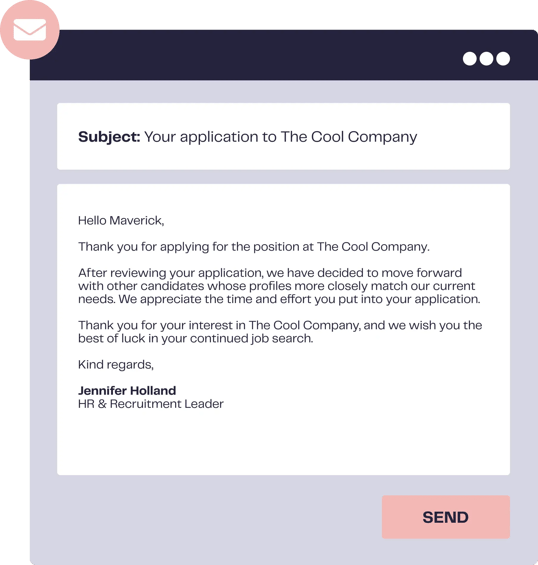
1. Job Rejection Email Template (No Interview) - Neutral
Unlikely to consider for future roles
Goal: Provide clear closure while maintaining a professional tone, without encouraging future applications or implying ongoing interest.
|
Subject: Your application to [Company Name] Hello [First name], Thank you for applying for the position at [Company Name]. After reviewing your application, we have decided to move forward with other candidates whose profiles more closely match our current needs. We appreciate the time and effort you put into your application. Thank you for your interest in [Company Name], and we wish you the best of luck in your continued job search. Kind regards, |
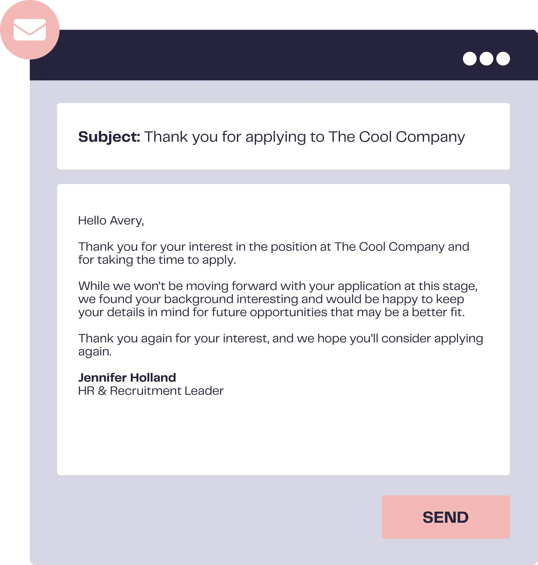
2. Job Rejection Email Template (No Interview) - Enthusiastic
Likely to consider for future roles
Goal: Close the loop while keeping the door open for future roles and encouraging the candidate to consider applying again
|
Subject: Thank you for applying to [Company Name] Hello [First name], Thank you for your interest in the position at [Company Name] and for taking the time to apply. While we won’t be moving forward with your application at this stage, we found your background interesting and would be happy to keep your details in mind for future opportunities that may be a better fit. Thank you again for your interest, and we hope you’ll consider applying again. Kind regards, |
3. Job Rejection Email Template (After Interview & Phone Call) - Neutral
Unlikely to consider for future roles
Goal: Provide clear closure while maintaining a professional tone, without encouraging future applications or implying ongoing interest.
|
Subject: Thank you for your time at [Company Name] Hello [First name], Thank you for taking the time to speak with us and for your interest in the role at [Company Name]. As discussed, we have decided to move forward with another candidate whose experience more closely matches our current requirements. We appreciate your openness and engagement throughout the process. Thank you again for your time, and we wish you every success going forward. Kind regards, |

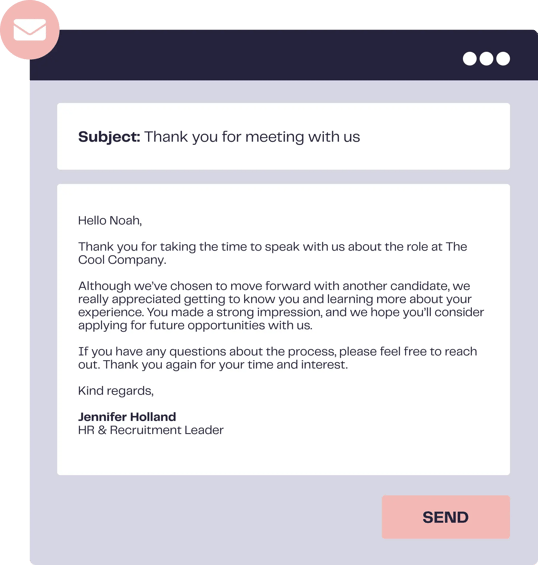
4. Job Rejection Email Template (After Interview & Phone Call) - Enthusiastic
Likely to consider for future roles
Goal: Reinforce a positive candidate experience and signal continued interest in the candidate for potential future opportunities.
|
Subject: Thank you for meeting with us Hello [First name], Thank you for taking the time to speak with us about the role at [Company Name]. Although we’ve chosen to move forward with another candidate, we really appreciated getting to know you and learning more about your experience. You made a strong impression, and we hope you’ll consider applying for future opportunities with us. If you have any questions about the process, please feel free to reach out. Thank you again for your time and interest. Kind regards, |
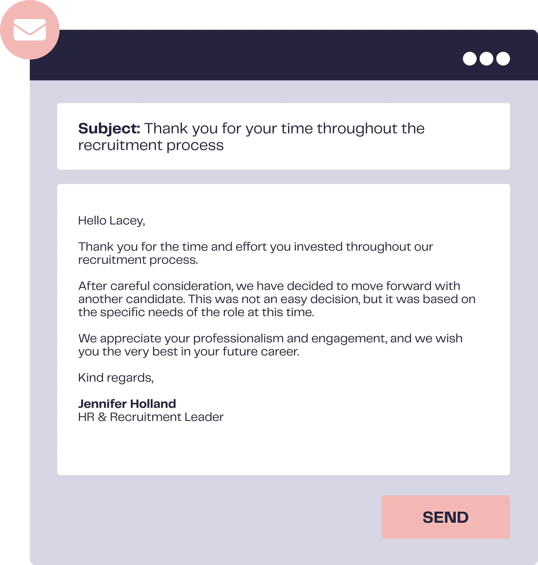
5. Job Rejection Email Template (After Multiple Interviews & Phone Call) - Neutral
Unlikely to consider for future roles
Goal: Thank the candidate for significant involvement while clearly closing the process without setting expectations for future roles.
|
Subject: Thank you for your time throughout the recruitment process Hello [First name], Thank you for the time and effort you invested throughout our recruitment process. After careful consideration, we have decided to move forward with another candidate. This was not an easy decision, but it was based on the specific needs of the role at this time. [Optional - Provide personal feedback here if appropriate] We appreciate your professionalism and engagement, and we wish you the very best in your future career. Kind regards, |
6. Job Rejection Email Template (After Multiple Interviews & Phone Call) - Enthusiastic
Likely to consider for future roles
Goal: Preserve a strong relationship with a high-quality candidate and encourage future engagement with your company.
|
Subject: Thank you for your time and engagement with [Company Name] Hello [First name], Thank you for the significant time and commitment you’ve shown throughout our recruitment process. While we have decided to move forward with another candidate, we were genuinely impressed by your experience and approach. You are someone we would be happy to stay in touch with, and we hope you’ll consider future opportunities at [Company Name]. If you have any questions or would like additional feedback, please don’t hesitate to reach out. Thank you again for your interest and engagement. Kind regards, |

FAQ About Recruitment Emails
How do you write a professional job rejection email?
A professional job rejection email should be clear, respectful, and timely. It should thank the candidate for their effort, communicate the decision directly, and avoid vague or misleading explanations.
Should you always send a rejection email?
Yes. Every candidate deserves closure. Even a short, neutral rejection email is better than no response and helps protect your employer brand.
When should you call a candidate instead of sending an email?
A phone call is recommended once a candidate has participated in interviews. The further they progress, the more personal the rejection should be.
Is it okay to use templates for rejection emails?
Yes. Templates ensure consistency and efficiency. The key is to adjust tone and content based on how far the candidate progressed and whether you want to encourage future applications.
What should you avoid saying in a rejection email?
Avoid overly generic phrases, false promises, or language that could be interpreted as discriminatory. Focus on role requirements over personal shortcomings.
Can recruitment software help with rejection emails?
Yes. Modern recruitment software allows you to automate rejection emails while still personalizing tone, timing, and content, improving both efficiency and candidate experience.
Next Steps: Improve Your Hiring Workflow
Rejection emails are often treated as an afterthought, but they shape how candidates remember your company.
By:
- choosing the right tone
- responding promptly
- using structured templates
- and supporting recruiters with automation
…you turn rejection into an opportunity to build trust, protect your employer brand, and strengthen your long-term talent pipeline.
The right processes and tools make it possible to treat every candidate with respect - even when the answer is no.
Ready to take the next step?
Download our free guide on Choosing the Right Recruitment System to help you evaluate your needs and find the perfect fit for your organization.