
This article was updated in December 2025 to reflect the latest information and best practices.
TL;DR
Employer branding in 2026 is about clarity, credibility, and candidate experience, not slogans.
To attract the right talent, HR teams need optimized career pages, employee voices, smart job distribution, referral activation, and early engagement.
This guide breaks down five actionable employer branding steps, backed by Nordic candidate data.
Table of Contents
- What does employer branding mean in 2026?
- Step 1: Optimize career pages for conversion
- Step 2: Let employees speak for you
- Step 3: Publish jobs in the right channels
- Step 4: Activate employee referral networks
- Step 5: Engage new hires before day one
- Employer branding solutions that support these steps
- The role of AI in employer branding
- FAQ: Employer branding in 2026
- Next steps
What Does Employer Branding Mean in 2026?
Employer branding in 2026 is defined by how clearly and honestly you show what it’s like to work at your company.
Talent shortages are expected to persist across most industries. Candidates compare employers quickly. What makes the difference is not messaging, but experience, transparency, and relevance.
Strong employer branding answers three candidate questions immediately:
- Do I belong here?
- Can I trust this employer?
- What will my experience actually be like?
Step 1: Optimize Career Pages for Conversion
Your career page is often not the first touchpoint, but it is the deciding one.
Talentech data shows that around 90% of candidates arrive via third-party platforms, such as job boards or social media, and most visits happen on mobile.
To convert interest into applications, avoid sending candidates straight to a generic form.
Instead, use role-specific landing pages that:
- Explain the role in context
- Show team, culture, and work environment
- Outline the recruitment process clearly
- Highlight benefits and expectations
A fast, mobile-friendly experience is non-negotiable. Broken links, slow load times, or cluttered layouts cost you candidates.
Want career pages that reflect your employer brand? See how dynamic career pages work >>>
Step 2: Let Employees Speak For You
Candidates trust employees more than HR or hiring managers.
Trust is the core reason employee voices matter in employer branding. Our 2026 HR Report consistently shows that employees are seen as far more credible than HR teams or hiring managers when assessing what it is really like to work somewhere.
According to the report:
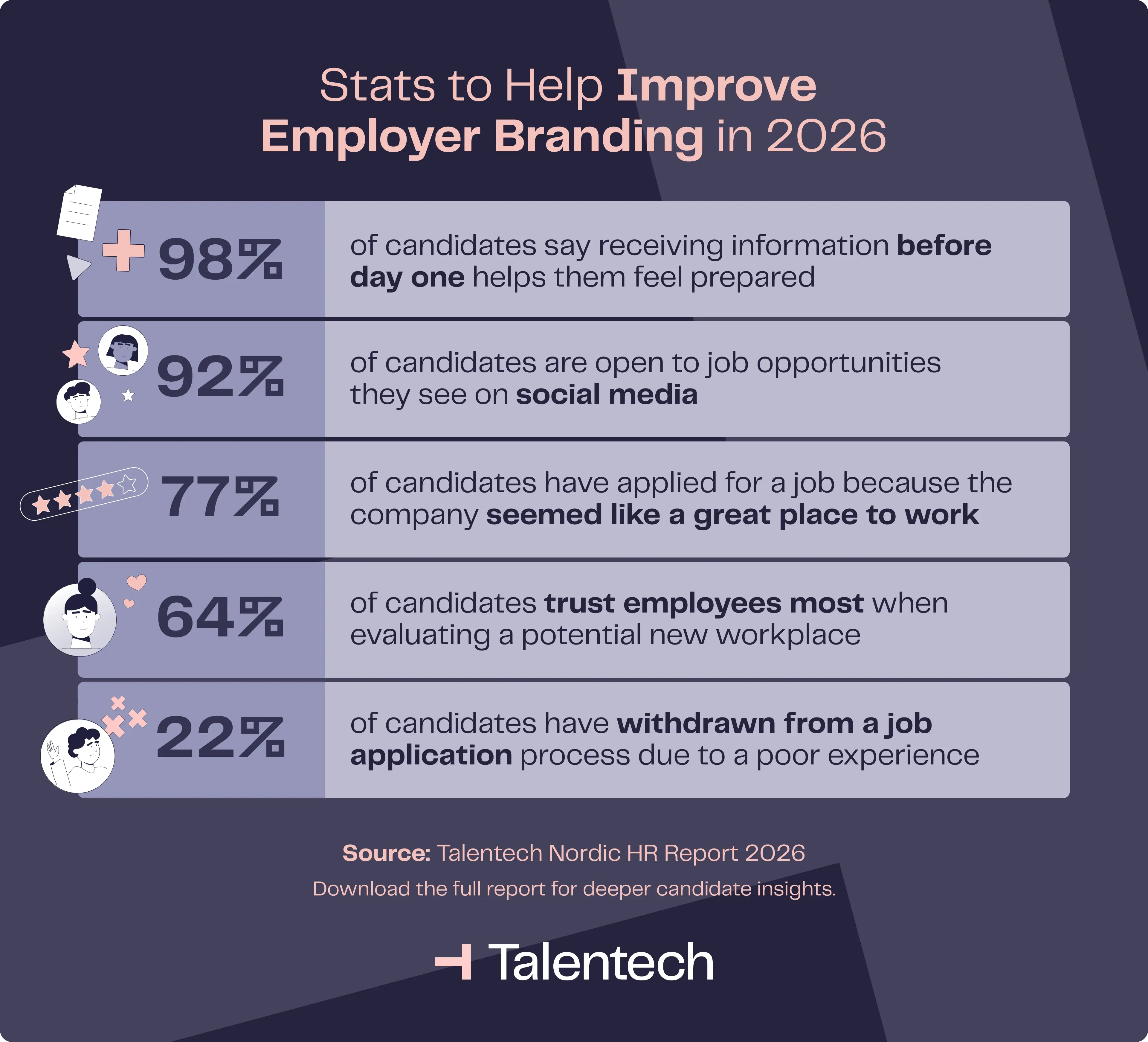
- 64% trust employees most when evaluating a workplace
- HR (11%) and hiring managers (14%) rank far lower
Employee stories provide credibility that no employer message can replace.
Effective employer branding examples include:
- Short employee video testimonials
- Day-in-the-life stories
- First-person insights on team collaboration
|
✅ PRO TIP |
|
Video performs especially well because it feels human and unscripted. |
Step 3: Publish Jobs in the Right Channels
Visibility alone is not enough. Relevance is what drives applications.
Talentech’s 2026 HR report shows:
- Job portals, LinkedIn, and company websites are the top job search channels
- 92% of candidates are open to opportunities they see on social media
To improve employer branding reach:
- Focus on platforms your target roles actually use
- Match channel choice to role seniority and skill set
- Combine organic content with targeted job ads
Want your jobs to reach the right candidates? Learn how recruitment marketing supports distribution >>>
🤖 AI Spotlight: How AI Can Help You Reach the Right Candidates
AI increasingly supports employer branding by helping HR teams match jobs with the right audiences, without adding complexity to daily work.
In practice, AI can:
- Optimize job distribution by prioritizing the channels most likely to reach relevant candidates
- Improve timing and visibility, based on historical performance and candidate behavior
- Reduce wasted spend by limiting exposure in low-performing channels
- Ensure consistency in job messaging across platforms
Used this way, AI helps HR teams spend less time managing distribution and more time improving the candidate experience.
Step 4: Activate Employee Referral Networks
Your employees are more than just ambassadors; they’re distribution channels.
Referrals strengthen employer branding because they carry personal endorsement, not just reach. A job shared by an employee signals cultural fit and credibility long before a candidate reads the job description.
When referral programs are easy to participate in, they turn everyday employee networks into a natural extension of the employer brand, without forcing advocacy.
Referral candidates often:
- Convert faster
- Stay longer
- Align better with company culture
To activate referrals:
- Make sharing jobs simple
- Provide ready-to-use content
- Recognize and reward participation
Want to activate employee referrals more easily? See how referral tools support sharing >>>
Step 5: Engage New Hires Before Day One
Employer branding does not stop at offer acceptance.
Silence between contract signing and day one creates uncertainty. From a candidate’s perspective, this gap can weaken trust and raise doubts about the decision they just made.
Preboarding closes that gap. It reinforces the employer brand at a moment when expectations are high, and reassurance matters most.
61% of new hires report limited contact between signing and their first day. This gap creates doubt, disengagement, and early attrition.
Preboarding helps maintain momentum by:
- Sharing practical information early
- Introducing team members
- Reinforcing company culture
In our 2026 HR Report:
- 98% say early information helps them feel better prepared
Want to engage new hires before day one? Explore preboarding and onboarding experiences >>>
Employer Branding Solutions That Support These Steps
Employer branding solutions should help HR teams deliver consistent, credible experiences, not add complexity or fragment the message.
In practice, effective employer branding software should enable HR teams to:
- Maintain consistent employer messaging across career pages and job ads
- Coordinate job publishing and visibility without manual effort
- Enable employee participation in a simple, structured way
- Support early engagement with candidates and new hires
When technology supports these fundamentals, HR teams can focus less on execution gaps and more on building an employer brand that candidates actually trust.
Want a birds-eye view of how Talentech supports your employer branding? Explore our employer branding software offering >>>
The Role of AI in Employer Branding in 2026
In 2026, AI is the support layer behind your employer brand.
The strongest employer brands still rely on human stories, transparency, and trust.
AI helps HR teams deliver those elements more consistently and at scale.
In employer branding, AI is most valuable when it:
- Supports personalization, without fragmenting the message
- Improves relevance, so candidates see content that actually fits them
- Removes friction, across applications and communication
- Provides insight, into what content and channels perform best
The goal is not automation for its own sake, but better execution of human-centered employer branding.
FAQ About Employer Branding
How can HR improve employer branding without a large budget?
Focus on employee voices, clarity, and candidate experience. These are low-cost, high-impact levers that build trust and improve how candidates perceive your workplace.
What are good employer branding examples?
Good employer branding examples include career pages with real employee stories, a transparent recruitment process, clear role expectations, and consistent messaging across job ads and channels.
Is employer branding only about attracting candidates?
No. Employer branding also affects retention, engagement, and how employees talk about your workplace. It shapes trust across the full candidate and employee journey.
Does employer branding software matter?
Yes, when it reduces friction and supports consistent experiences. The right employer branding software can help coordinate career pages, job publishing, employee advocacy, and early engagement without adding manual work.
Can AI replace employer branding work?
No. AI can support employer branding by improving relevance, distribution, and consistency, but trust, culture, and credibility still come from people and real experiences. AI works best as an enabler, not a substitute.
Next Steps: How to Improve Your Employer Branding
Employer branding in 2026 is about earning trust before the first conversation.
If you want deeper insights into:
- Candidate expectations
- Employee perspectives
- Nordic hiring trends
Download the Talentech Nordic HR Report to guide your employer branding priorities for the year ahead.